For decades, the moment a material web is wound into a roll, it enters a "black box" where visibility dies. In high-stakes sectors like battery electrode production, flexible packaging, and nonwovens, manufacturers have long wrestled with a persistent, expensive problem: the "ghost in the machine."
Once a roll is coiled, the exact location of defects, splices, and quality anomalies essentially vanishes. The industry's reliance on ink marks, manual paper tags, and handwritten logs is a multi-million dollar liability hidden in plain sight. We are now seeing a strategic pivot toward the era of the Smart Roll — where digital mapping transforms passive material into data-bearing assets.
1. The Death of the Physical Tag
The most immediate operational shift is the total elimination of physical markers — and the manual labour that goes with them.
The Old Way:
In the traditional workflow, operators are tethered to the line, forced to "watch and catch" — manually inserting flags or marking edges to signal downstream processes where a defect might lie. This reliance on human intervention is the weakest link in the quality chain, prone to error, omission, and physical loss during transport.
The Digital Shift:
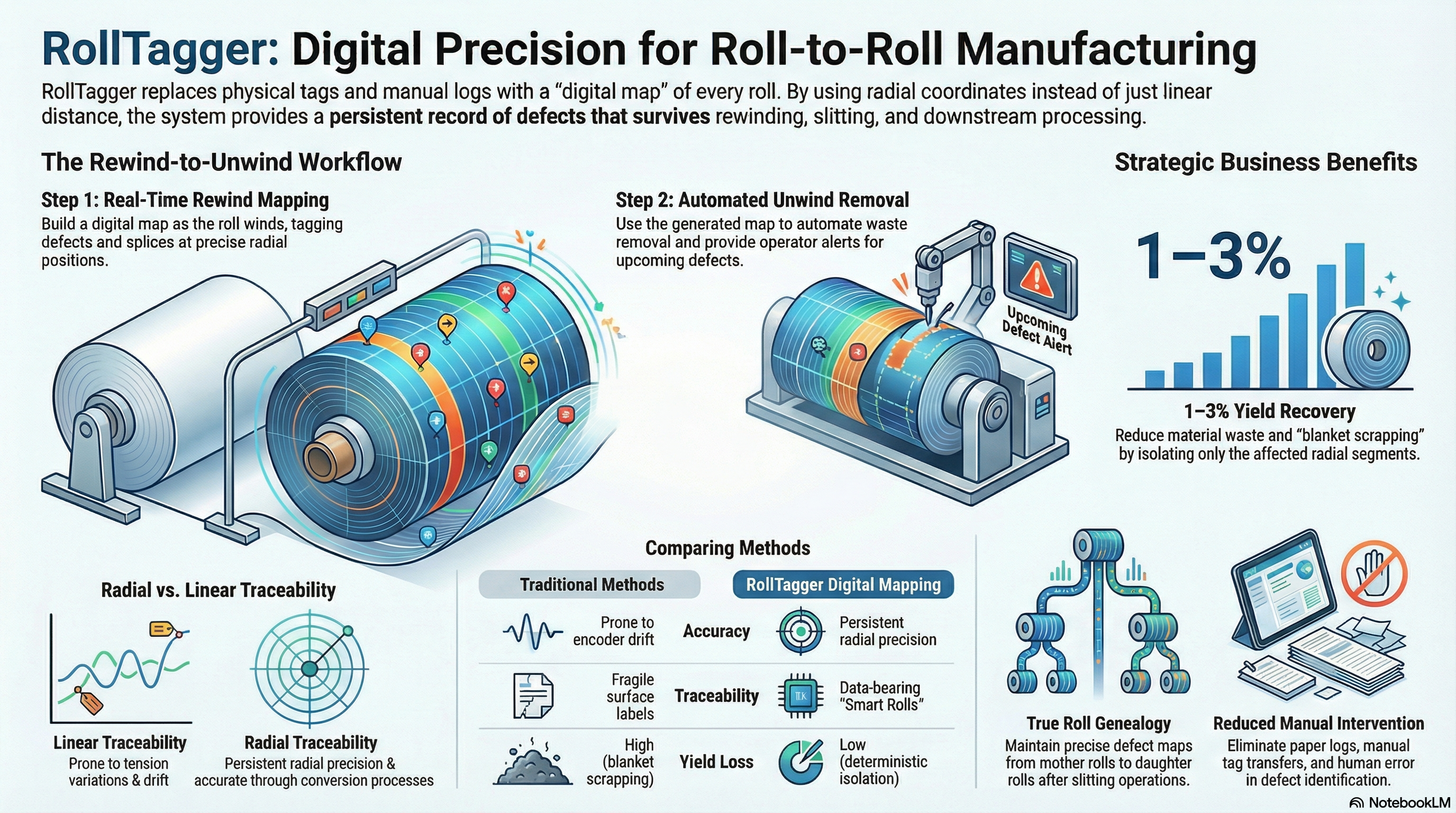
Digital mapping replaces manual watching with high-fidelity automated recording. As the material winds, the system latches every quality event — timestamps, linear offsets, and precise wind locations — automatically. No physical tags. No manual watching. The data moves with the material in a virtual environment, immune to the fragility that plagues traditional tagging.
2. Why "Linear Distance" is a Lie (and Radius is Truth)
Tracking material by linear distance via encoders is a fundamental technical compromise — and one that compounds over long web lengths.
The Encoder Drift Problem:
Over long web lengths, "encoder drift" is an inevitability, exacerbated by tension variations, material slippage, or sagging. In short, linear distance is often a lie. An encoder might lose its place — but the physical layer of the material, expressed as its specific radius from the core, stays exactly where it is.
Radial Position Referencing:
Instead of relying on a cumulative length that can stretch or skip, the system identifies position based on a formula intrinsic to the roll's physical geometry:
Position = f(Core Radius + Layer Thickness + Wound Layers)
Because radial position is a structural property of the roll, it remains accurate regardless of storage, transportation, or tension changes. A defect mapped at a specific depth on the rewind will be found at that precise depth on the unwind — every single time.
3. The "Map It, Then Remove It" Workflow
Digital mapping enables a streamlined, two-stage process that introduces deterministic defect isolation to the factory floor — replacing the tradition of discarding entire rolls due to uncertainty.
Rewind Mode:
As the mother roll is produced, the system generates a real-time digital map. It records diameter and thickness while marking defects and splices at exact radial coordinates — automatically, with no operator intervention required.
Unwind Mode:
During secondary processing, the system plays back the map. It provides "upcoming defect alerts" to prepare operators and signals machines to stop or adjust automatically. Unwind Verification compares actual vs. expected positions at every milestone — keeping the digital map synchronised with the physical material even if the roll has shifted during handling.
This surgical precision allows manufacturers to isolate and remove only the scrap segments, protecting the yield of the remaining high-quality material — rather than blanket-scrapping the entire roll.
4. Genealogy: Daughter Rolls Inherit the Mother's History
A common failure point in manufacturing is the "loss of identity" that occurs during slitting. When a large mother roll is slit into daughter rolls, the original quality data often fails to follow the new units.
The Slitting Problem:
Without persistent identity, there is no way to trace a customer complaint back to the specific radial coordinate on the mother roll where the defect originated — or to the line conditions at that moment in production. Root-cause analysis becomes guesswork.
Roll Lineage:
Because the data is tied to radial coordinates, daughter rolls inherit the precise positional mapping and defect history of the mother roll. RollTagger supports Multi-Process Defect Tracking — calculating material waste at each individual stage from coating to slitting to final conversion. Quality control becomes a data-driven competitive advantage.
5. The Surprising ROI of 1%
In high-volume industrial environments, a 1% improvement in yield is not a marginal gain — it is a massive financial windfall.
The Business Case:
Integrating digital mapping typically results in a 1–3% yield recovery, which for top-tier converters translates into hundreds of thousands to millions in annual savings. With a typical ROI period of 6–18 months, the investment justification is clear.
Four Drivers of ROI:
- Reduced Scrap — Moving from blanket scrapping to deterministic defect isolation
- Lower Investigation Labour — Eliminating manual searching, paper-log audits, and floor detective work
- Fewer Quality Claims — Precise data containment prevents defective material from reaching the customer
- Operational Readiness — Automated wind verification identifies sagging or cuts before they cause downstream downtime
From Passive Material to Strategic Intelligence
The transition from linear-based estimation to radius-native digital identity is the foundational step for next-generation manufacturing intelligence. By converting passive material rolls into smart, data-bearing assets, manufacturers gain a durable identity that survives the entire lifecycle of the product.
As we move toward a future of autonomous quality control and digital twins, the question for leadership is no longer about the cost of implementation — it is the cost of inaction. Is your process still relying on fragile surface labels and the guesswork of linear encoders, or are you ready to unlock the potential of the Smart Roll?
Moving beyond the physical tag is the only way to build a foundation of strategic intelligence for the future of industrial production.