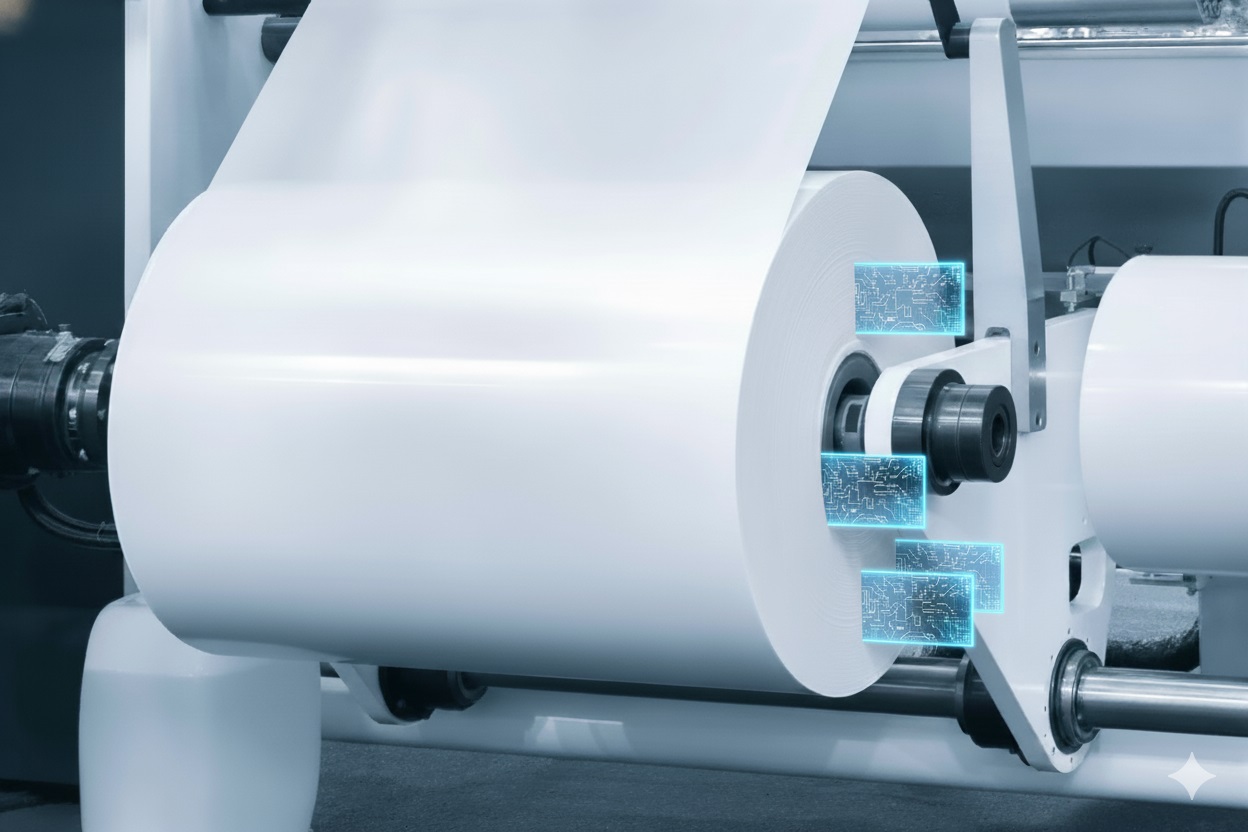
RollTagger roll tracking

Support

Documentation, FAQs, and everything you need to get the most from RollTagger

Documentation

Quick access to guides, demos, and reference pages

Frequently Asked Questions

Everything you need to know about RollTagger

  • RollTagger replaces the need to put physical tags in your roll
  • Tags can still be used and marked in the roll map
  • Wind number, radial offset from core, and linear displacement are all stored
  • RollTagger works with vision systems and other online measurement solutions to mark waste
  • Exact location stored — no physical flag needed
  • Uses only commercially off-the-shelf hardware
  • Software runs on the RevPi Connect 4 industrial controller (preferred), standard PLCs, or industrial PCs
  • Interfaces with standard encoders via RS485 Modbus — preferred encoder is the BRT absolute rotary series

Rewind Mode:

  • Used when creating new rolls from raw material
  • Records all encoder data, geometry calculations, and quality events
  • Position counts up from 0
  • Operators can tag defects, splices, and quality checks in real-time

Unwind Mode:

  • Used when processing existing rolls created elsewhere
  • Plays back events from the source rewind
  • Can control machine through supported industrial interfaces
  • Position counts down from target length to 0
  • System checks for material removal using automated wind verification
  • Controllers cluster using ISA 95 hierarchy and automatically discover each other on the network
  • Each process runs in rewind mode (recording) or unwind mode (reading) depending on position in production flow
  • As rolls move from print → laminate → coat → slit, defects accumulate at each stage
  • Virtual unwinding with path length delay ensures events align properly when transferred between processes
  • Print defects carry forward to laminating, then print + laminate defects carry forward to coating
  • Material waste percentage is calculated at each unwind stage, maintaining complete roll lineage
  • Example: 3 rewind stations (print, laminate, coat) feeding 1 unwind station (slitter) with full defect visibility

RollTagger uses a three-queue architecture:

  • Input Queue: Rolls awaiting processing (FIFO order)
  • Output Queue: Completed rolls pending export or transfer
  • Backlog: Historical archive with configurable retention (default: 90 days)

All queue operations use atomic SQL to prevent race conditions and guarantee FIFO ordering.

  • Automated quality check at every 10-wind milestone during unwind
  • Compares actual position to expected position from source rewind
  • Calculates deviation in meters and percentage
  • Status indicators: OK (within tolerance), Warning (minor deviation), Critical (exceeds threshold)
  • Real-time alerts sent to the operator
  • Each roll event causes the real-time latching of rewinder RPM, radial position, and number of winds
  • System also measures inter-wind linear displacement
  • When using dual encoders the system will measure diameter and thickness of the material
  • Designed for offline-first operation
  • All data stored locally in SQLite databases on each device
  • Network connectivity only needed for device-to-device transfers when enabled
  • Operates independently without cloud dependency
  • Licensed by end user or reseller
  • Perpetual or subscription solutions available
  • Hardware purchased and installed by end user or OEM
  • RollTagger software can be installed as a service remotely